AI Agents in 2026: The Future of Autonomous Digital Workers
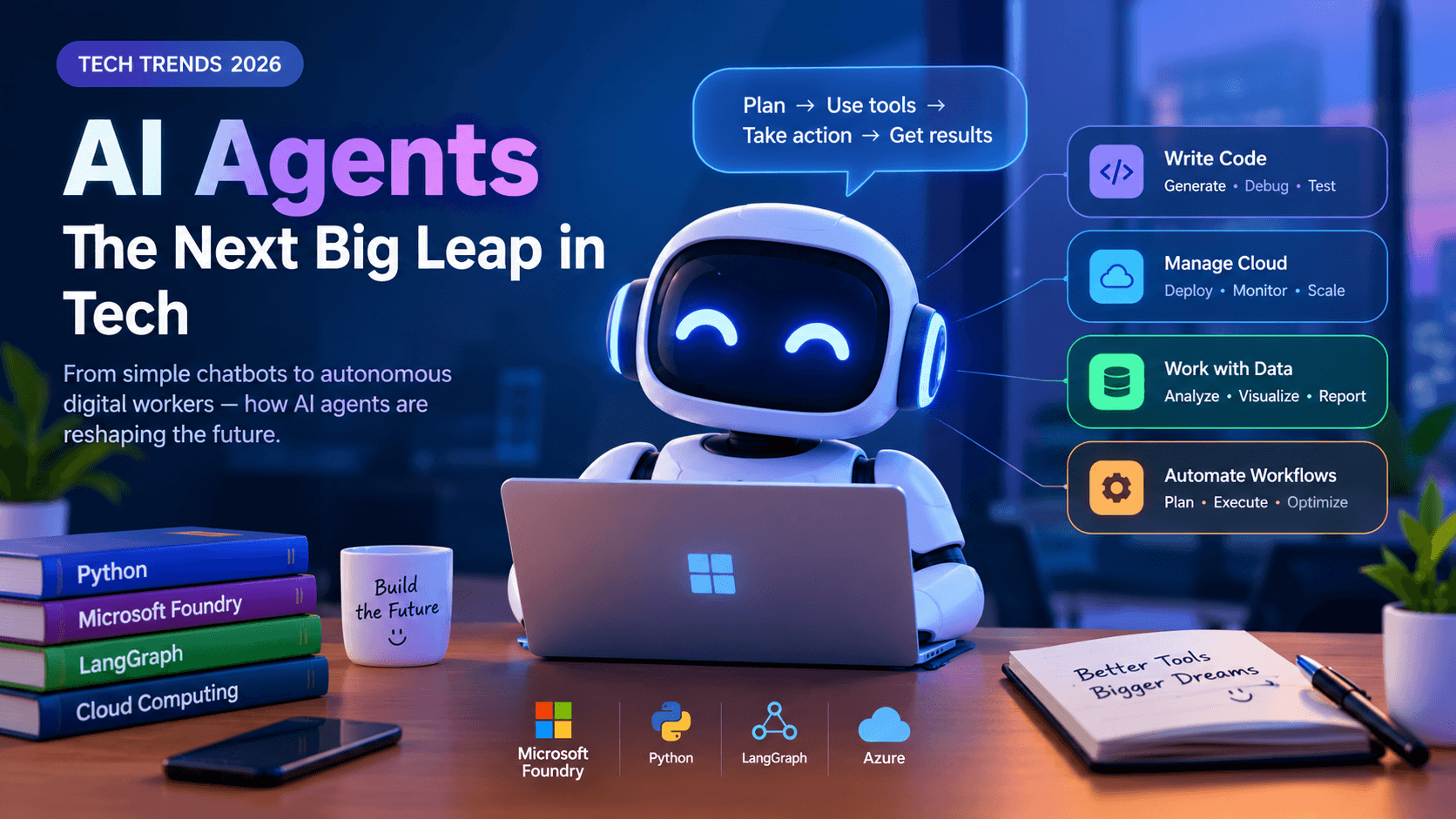
What If Your Next Employee Is an AI Agent?
Imagine asking an AI to build a website, test its code, identify bugs, and prepare it for deployment. Instead of simply providing instructions, an AI agent could work through these steps using the tools and permissions available to it.
Welcome to the world of agentic AI — a rapidly developing technology that is changing how people interact with software, automate workflows, and solve complex problems.
What Are AI Agents?
AI agents are systems that use artificial intelligence to pursue goals by planning tasks, interacting with tools, retrieving information, and taking actions. Unlike a traditional chatbot that primarily responds to prompts, an agent can coordinate multiple steps toward completing a task.
- Break complex tasks into manageable steps.
- Use APIs, databases, and external tools.
- Execute multi-step workflows.
- Evaluate results and adjust their approach.
- Collaborate with other agents in supported systems.
The degree of autonomy varies. Human approval and appropriate safeguards remain essential for important or sensitive actions.
1. AI Agents Are Transforming Software Development
AI coding tools are evolving beyond code suggestions. Depending on the tools and permissions available, coding agents can inspect repositories, implement features, run tests, investigate errors, and prepare changes for human review.
For example, a web developer could use an agent to help investigate a broken component, propose a fix, run available tests, and summarize the changes. This can reduce repetitive work while allowing developers to focus on architecture, performance, accessibility, and user experience.
2. Microsoft Foundry and the AI Agent Ecosystem
Microsoft Foundry provides tools for building and managing AI applications and agents. Developers can explore model integrations, tool calling, knowledge retrieval, evaluation, and deployment workflows.
Other technologies worth exploring include Python, large language model APIs, LangGraph, and the Model Context Protocol (MCP), which can help connect AI applications to compatible tools and data sources.
The important lesson is that an effective agent needs more than a language model. It also needs useful tools, reliable data, clear instructions, testing, monitoring, and appropriate access controls.
3. Real-World Applications of Agentic AI
- Customer support: Investigating issues and preparing responses.
- Cloud computing: Assisting with monitoring, deployment, and operational workflows.
- Business automation: Processing documents and coordinating repetitive tasks.
- Data analysis: Retrieving approved information and preparing reports.
- Cybersecurity: Helping analysts investigate alerts and identify suspicious activity.
- Marketing: Supporting research, campaign planning, and content workflows.
These applications can improve productivity, but their real value depends on accuracy, reliability, integration costs, and the quality of human oversight.
4. The Biggest Challenge: Trust and Security
Giving an AI system the ability to take action introduces risks. An agent might misunderstand a request, access information it does not need, or act on malicious instructions hidden in external content.
Organizations should implement:
- Least-privilege access permissions.
- Human approval for high-impact actions.
- Audit logs and activity monitoring.
- Testing and evaluation before deployment.
- Protection for confidential information and credentials.
The goal is not simply to build more autonomous agents. It is to build agents that are useful, secure, observable, and accountable.
5. How to Start Learning AI Agents
If you are a student, developer, or cloud computing professional, consider starting with these technologies:
- Programming: Python, JavaScript, or TypeScript.
- AI development: LLM APIs, structured outputs, and tool calling.
- Agent frameworks: LangGraph and Microsoft's agent development tools.
- Cloud: Microsoft Azure, AWS, or Google Cloud.
- Deployment: Docker, CI/CD, logging, and monitoring.
- Security: Authentication, authorization, and safe tool execution.
A great first project is a research assistant that retrieves information from approved sources, summarizes the results, and provides links to the original material. Add testing, error handling, and access controls before expanding its capabilities.
What Does the Future Hold?
AI agents could become increasingly integrated into software development environments, enterprise applications, and everyday workflows. Multi-agent systems may also help coordinate specialized tasks, although reliability, cost, security, and practical limitations will continue to influence adoption.
For developers, the opportunity is to learn how to connect AI models with real tools and build applications that solve meaningful problems — not simply create another chatbot.
Let's Discuss!
If you could have one AI agent working for you today, what task would you automate first?
- Building and testing websites?
- Managing repetitive business tasks?
- Analyzing data and generating reports?
- Helping you learn new technologies?
Share your answer in the comments. I would love to hear what you would build with AI agents!
What do you think: Will AI agents become essential digital coworkers, or will security and reliability remain the biggest barriers?
#AIAgents #AgenticAI #MicrosoftFoundry #CloudComputing #SoftwareDevelopment
```